
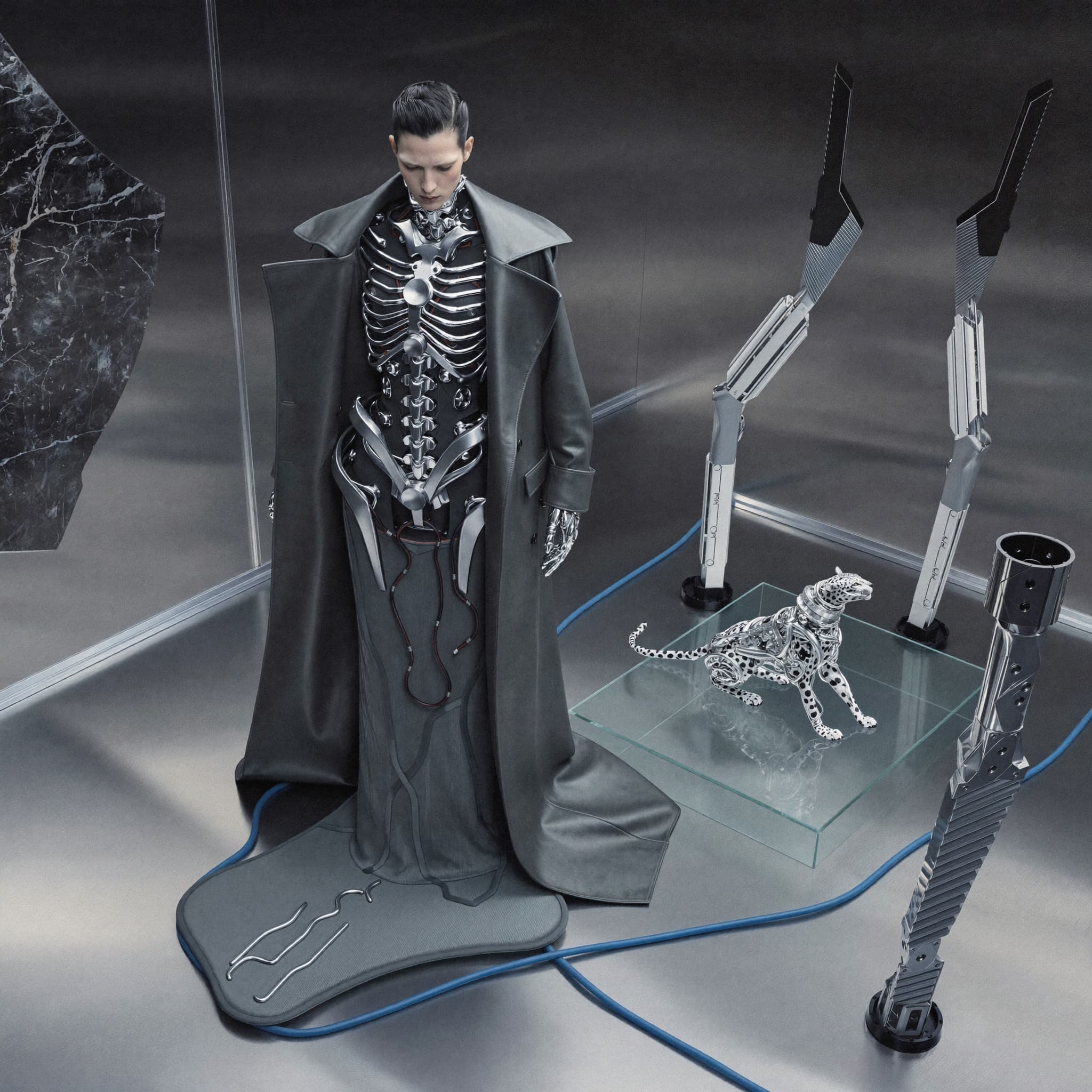

Overview & Visual Direction
The Sochit Stylysta archive explores what happens when sterile industrial garments are left exposed to biological overgrowth and environmental wear. Instead of relying on standard neon cyberpunk tropes, these five visual studies focus on tactile friction: cold brushed metals colliding with damp moss, translucent plastics stretched over rigid frames, and dusty pastel armor paired with heavy utility gear. The lighting remains controlled and studio-focused, isolating each silhouette so the surface seams and material transitions carry the visual weight.
Material & Texture Breakdown
- Translucent Mesh & Polymer Webbing: The first study pairs a matte grey structural harness with semi-transparent synthetic sleeves. Against a dark, rough backdrop, the clear vinyl catches rim lighting while keeping the underlying geometric grid visible.
- Botanical Parasitism on Steel: In the second look, a tailored metallic-grey jacket is partially colonized by dense patches of green moss. Keeping the background a flat, cold slate (
#3A434A) prevents the organic green from looking decorative, treating it instead like rust or natural patina. - Bio-Resin & Liquid Chrome: The close-up portrait shifts to a clinical teal background (
#3B7A82), highlighting a sculpted, semi-translucent green resin mask embedded with moss and silver tendrils. The contrast between wet metallic reflections and matte plant fibers creates a strong focal point for editorial styling. - Weathered Matte Hardware: Moving away from dark tones, the fourth study introduces a scuffed matte pink tactical helmet (
#C7949B) worn over a black quilted collar and heavy industrial respirator. The dusty surface finish softens the aggressive silhouette of the mask. - High-Gloss Latex & Webbing: The final piece contrasts a sleek black leather-like bodysuit against tangled, white cobweb-like fibers. Shot vertically in low-key lighting, the white threads act as natural leading lines across the dark frame.
Practical Design Applications
For apparel designers, stylists, and 3D character artists, this series functions as a modular moodboard for surface treatment and layering:
- Streetwear & Outerwear: Combining matte pastel shells with heavy dark hardware offers a fresh colorway direction for technical outerwear.
- Editorial & Costume Prop Design: Mixing clear PVC or cast bio-resin with raw organic textures works well for sculptural masks and runway accessories.
- 3D Shader & Texture Reference: The interplay between subsurface scattering (on the resin mask) and high-specularity surfaces (on the black bodysuit) provides clear lighting benchmarks for digital garment rendering.
Studio Notes & Technical Artifacts: When reviewing these renders for print or high-resolution reference, a few generation artifacts remain visible upon close inspection—specifically minor finger distortion on the raised hand in the bio-resin mask portrait and softened fabric edges along the transparent sleeve seams. For large-format wall prints or lookbook layouts, the black-and-white cobweb suit and the matte pink helmet compositions offer the cleanest edge definition and strongest thumbnail contrast.